
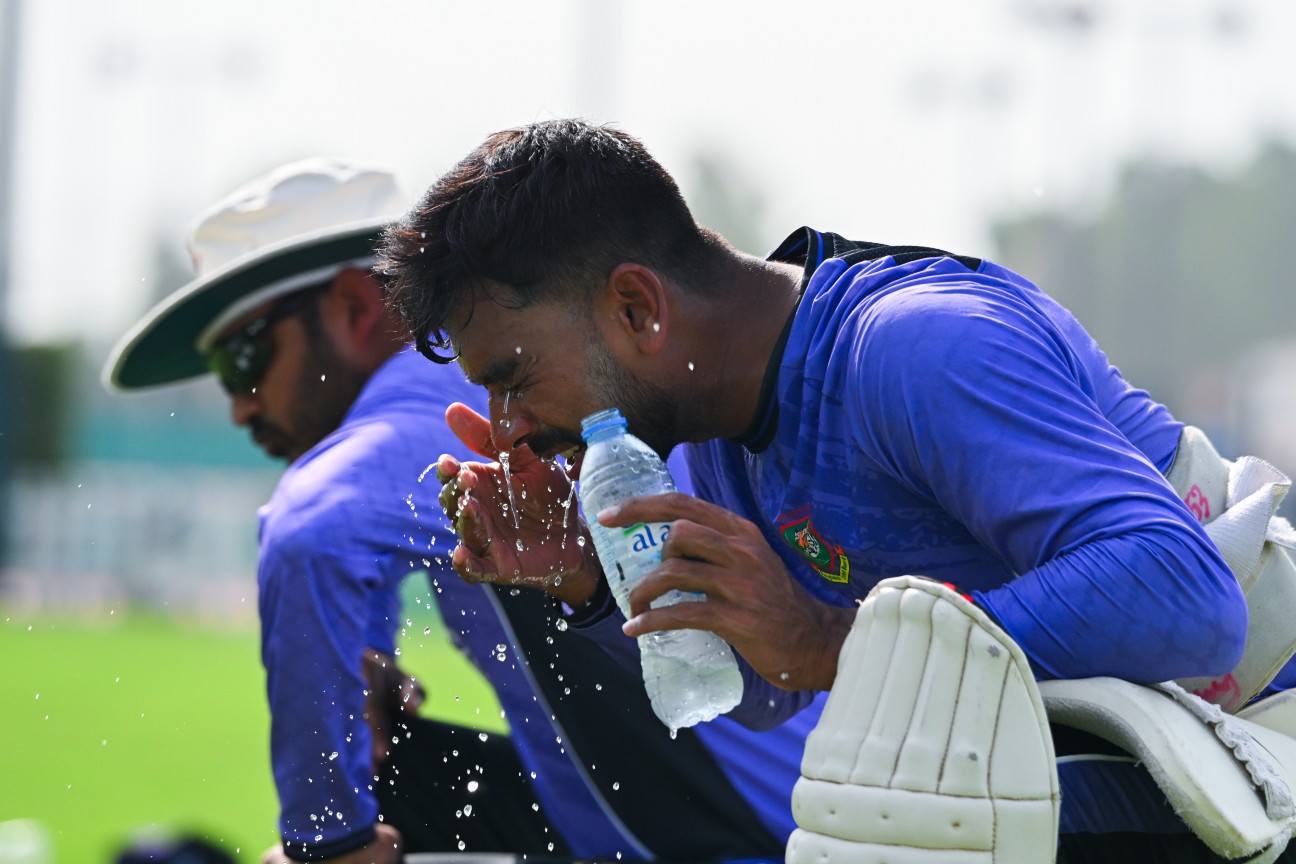

The two teams will face each other in a one-off Test at the Sheikh Zayed Cricket Stadium in Abu Dhabi, beginning tomorrow.
For Bangladesh, the challenge will not only be to deal with Afghanistan but also to adapt to unfamiliar conditions.
The match will also hold a special place in Bangladesh’s Test history for another reason as Bangladesh will play a Test at a neutral venue for the first time.
They have previously played two Tests against Afghanistan, both on home soil. This time, Afghanistan are the designated home side, but the match is being played in the United Arab Emirates.

Bangladesh’s record against Afghanistan in Test cricket has been mixed. In their first meeting in Chattogram in 2019, Bangladesh suffered a 224-run defeat. Four years later, in 2023, Bangladesh responded emphatically by defeating Afghanistan by a massive 546 runs in Mirpur. As a result, the two teams are currently level at 1-1 in their Test head-to-head record.
However, the circumstances are different this time. Along with dealing with the intense heat in Abu Dhabi, Bangladesh will have to counter Afghanistan’s spin attack while quickly putting their own batting and bowling plans into practice.
That is why Test captain Najmul Hossain Shanto has placed emphasis on adapting to the conditions ahead of the match.
“We had a good series against Australia. But that is in the past. This is a new condition and a new opponent. So we have to plan accordingly. Some of our players arrived a little earlier and played a practice match. That will help us adapt to these conditions. So I believe the players are ready and they will adapt to the conditions and the opposition,” Shanto said.
The visitors have had a good preparation ahead of the Test. Several members of the Test squad travelled to the UAE early and played a two-day practice match.
Bangladesh have also shown some consistency in Test cricket in recent times. Shanto credited the team’s hard work for the improvement in the longest format, although he believes maintaining their standards against different opponents and in different conditions remains a major challenge.
“Over the last few years, we have been playing good cricket, especially in this format, and that is what we wanted as a Test team. We are really working hard to try to improve our Test cricket. I believe we have a lot of work to do to improve our skills, especially in this format, and we have to be consistent in different conditions and against different opponents. As we said, we have played good cricket, but there are still many things we need to improve,” he said.
Meanwhile, with the growing demands of franchise cricket and the packed schedule of limited-overs leagues in modern cricket, Shanto was also asked about the difficulty of maintaining players’ interest in Test cricket.
For Shanto, however, the longest format still has a special appeal. As a professional cricketer, he spoke about his love for red-ball cricket despite the increasing demands of limited-overs cricket.
“It is difficult nowadays, but there is nothing we can do about it. But as professional cricketers, and when we were growing up, we all wanted to play Test cricket. If you ask most cricketers, they will all tell you that we all wanted to play Test cricket. So Test cricket will always be very special for any player.
“So I believe that if we play more matches and series against all opponents nowadays, the attraction will remain the same. But we cannot stay away from the shorter formats either. Still, we all love playing Test cricket, and I want to play more Test matches than shorter-format games.”
With their memorable Australia success now behind them, Bangladesh will look to start a new chapter in Abu Dhabi, where adapting quickly to the conditions and Afghanistan’s strengths could prove crucial in the one-off Test.